
What does sustainability mean when it comes to the food we eat? Defining common terms
I think it’s safe to say that we all want to eat food that contributes to our health, and most of us understand the basics of what that looks like to one degree or another. But what about eating in a way that protects the earth and takes the treatment of animals into consideration?
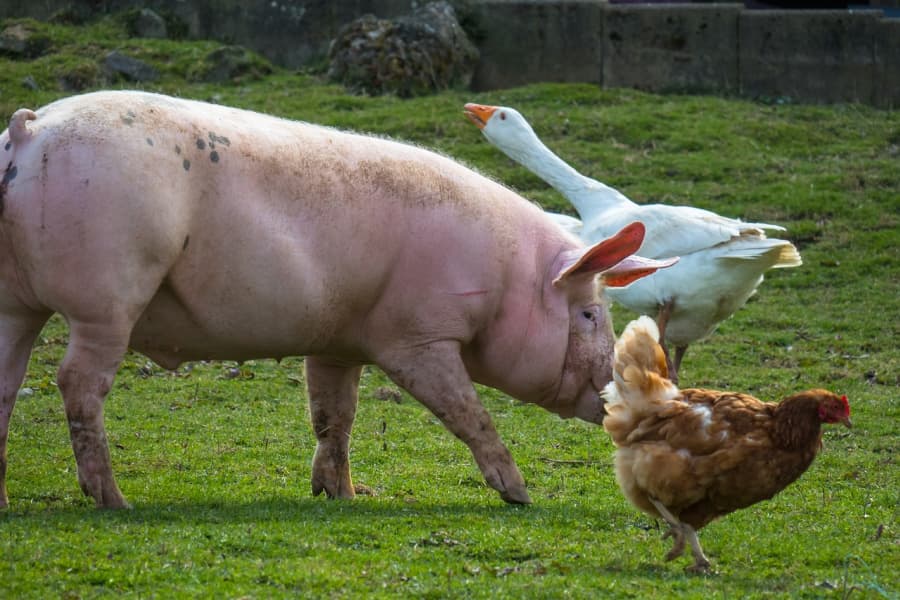
Do you know the difference between cage-free, free-range, and pasture-raised chickens? What about the difference between farmed, wild, and wild-caught fish? And what in the heck is GMO?
The first step in sustainable eating is to understand the terms, so here is a beginner’s glossary.
Sustainable eating glossary
Antibiotic-free: is not an approved claim because the USDA can’t verify that a product is completely free of antibiotic residue. No antibiotics administered, no antibiotics added, and raised without antibiotics claims are allowed by the USDA if producers can prove that no antibiotics were added or administered at any point in the animal’s life.
Cage-Free: While it’s true that eggs bearing this label on the carton come from hens who were not raised in cages, it’s still possible that they were raised in enclosed, windowless sheds. Chickens and turkeys raised for meat may also have been raised in an enclosed environment (sometimes with disrupted light patterns), despite being technically cage-free.
Farmed fish: Farmed fish are spawned, raised, and caught in a hatchery. They never leave the pen.
Free-Range: There is no legal definition, so conditions can vary greatly. In order to put this claim on a label, the producer must prove simply that animals have “access to the outdoors.”
Genetically Modified Organism (GMO): GMO refers to a plant, animal, microorganism, or other organism whose DNA has been changed or modified in some way through genetic engineering. The support for GMOs is centered mainly around being able to provide enough food for a growing global population, and the concern for GMOs is centered mainly around safety. The labeling of GMOs is voluntary in the U.S. and Canada, but required elsewhere in the world. In order to have a GMO-free label, the product must be verified through The Non-GMO Project.
Grass-Fed: While access to a pasture is required for most of the animal’s growth period, antibiotics, hormones, and some feedlot access (at the end of life) is allowed.
Humanely Raised/Humanely Handled: There are no clear USDA standards at present.
Natural: Because the USDA definition relates to how food is processed after slaughter, it doesn’t tell us much about the way in which an animal was raised.
Naturally Raised: There are currently no clearly established guidelines.
Pasture-raised: This term refers to animals that spend most of their lives on pasture and have access to graze and forage. A pasture-raised cow is not necessarily a grass-fed cow, because it might be fed grain by a farmer, especially in the winter if the farm is in a cold climate where snow covers the pasture.
USDA Certified Organic: Organic is a label that indicates that a food or agricultural product has been produced according to the USDA organic standards, which require operations to use practices that cycle resources, conserve biodiversity, and preserve ecological balance. The USDA’s National Organic Program develops and enforces the standards for organic crops, livestock, and agricultural products so consumers can feel confident purchasing organic goods.
Wild fish: Fish that are hatched, grow, and are caught in their natural environment are referred to a wild.
Wild-caught fish: A wild-caught fish hatched and partially raised in a hatchery and then released into a wild environment before it is fully matured.
Farmed fish: Farmed fish are spawned, raised, and caught in a hatchery. They never leave the pen.
Learn more
If you’d like to know more about these terms or sustainable eating in general, here are some respected resources:
The Food and Agriculture Organization of the United Nations
The United States Department of Agriculture (USDA)
The United States Food and Drug Administration (FDA)
Environmental Protection Agency (EPA)
The Non-GMO Project
HowGood
Your turn
- Are any of these terms new to you?
- Do you read labels when grocery shopping?
- What else is on your mind? Anything at all; I just love to hear from you.






I didn’t know about the lack of criteria regarding “natural” or “naturally raised.” The other terms I was aware of to some degree. I read labels, my mother got me doing that with her when I was younger and the habit has stayed with me. I cannot digest some artificial sweeteners so I’m hyper aware of what makes something sweet.
Your mother taught you a valuable skill, Ally. When I was younger, I would look at calories, fat, and sugar. Now I’m much more interested in natural ingredients and sustainability. A lot of these definitions are new and valuable to me.
Interesting. I only recently learned the difference between cage free and free range from a commercial, and it sounds like even then you don’t know how well the chickens are treated. I guess the only way to really know what you’re eating, as well as how the animals were treated would be to raise your own, or hunt and fish in the wild.
It has been eye-opening to me as well, Cindy. When I can find pasture-raised I choose that. It also seems that in most cases Certified Organic is best overall the environment. But you are right, living off the land directly is the only way to truly know what you are getting.
Hi Christie – so many terms! I try to buy from gentler farming methods wherever I can – the idea of caged chickens and tightly penned animals is just a bit sad really. I think farming methods are improving as customers require more humane methods.
I agree, Leanne. The images I’ve seen of chickens and other animals in crowded, inhumane conditions are heartbreaking. I haven’t convinced myself to go vegetarian, but I definitely am more aware of the conditions the animals are kept in while they are alive.
Hi Christie,
I found it interesting to see these terms. I’m pescatarian but cook meat for my partner, as I have always done for my family. I’m very fussy about the meat that I buy for him. I’m quite happy to pay extra for pasture fed. Here it is usually quite a bit extra. I also try to source with low food miles and in season. Great post.
You are so kind to accommodate your loved ones with foods you do not eat, Jennifer. I agree with you that paying extra for food that is healthier for you and for which the animals have been treated in a kinder manner is worth the extra cost. Also, you bring up a good point about choosing foods in season and grown locally whenever possible. They are also richer in nutrients and gentler on the environment.
Hi Christie, usually I’d be one of the ones who’d be new to these terms but I’m pleased to be able to say they are all familiar to me. In one of my corporate jobs I was a Policy Officer in Sustainable Agriculture and so these terms were part of my day to day. It’s such a good idea to post them and what they are so that others become familiar with them too. This knowledge truly does affect how I shop! Thanks for sharing and for linking up with #WWWhimsy xo
I love that there is a position of Policy Officer in Sustainable Agriculture, such an important role to fill. I am happy that people in general are becoming more knowledgeable about sustainability when it comes to our food.
Interesting post. It seems like what a lot of what you think you’re getting isn’t really what you’re getting! Thanks for the definitions. I’m going to bookmark this even though I was familiar with all of them. Knowing the differences was another matter.
https://marshainthemiddle.com/
It is sadly true that food labeling is often deceptive, Marsha. I remember the hey day of terms like “healthy” and “light” being thrown around without anything substantial to report them. Now it seems that as consumers become more conscious of how we are affecting the earth, marketers are jumping on that bandwagon.
Hi Christie, thanks for sharing these important terms. I knew most of them as we have similar terms here in Australia. I try to ensure we eat mostly clean with things like free-range eggs and local meat from the great butcher we have here in town.
That’s great you have a butcher in town, Deb. I understand there is a ranch not far from us that sells beef, and I’d like to try it. I haven’t sourced other local meets, but now I think I will.
Living in the UK, we are fortunate that our previous membership of the European Union means that we have decent and measurable food labelling regulations. Of course, we don’t *have* to meet them anymore, but it seems likely that our change of government from last year will be more inclined to keep than to discard.
It is terribly tricky, as there are so many ways for large organisations to suggest their produce is natural/organic/ethically produced, and we see a lot of that. It’s tiring having to stay on your toes, read labels, and stay up to date with what’s legislation and what’s flannel. I don’t imagine this aspect will change much in the decades to come, sadly.
Labels certainly can be tricky, Debs. It falls on us to research and just do the best we can. Small incremental improvements are still improvements, right?