
Is buying organic produce worth the added cost?
You’re wandering through the grocery store…list in hand…and you see the organic produce next to the “regular” produce, and you ask yourself once again, “Is buying organic worth the added cost?”
The short answer is “Maybe. Sometimes.”
If you were hoping for more than that, you are in luck.
Each year, the Environmental Working Group, a nonprofit environment group, publishes a Shopper’s Guide to Pesticides in Produce, using the USDA’s most recent testing. The guide includes a Dirty Dozen (those items with the highest amounts of pesticide residues) and a Clean Fifteen (those items with the lowest amounts of pesticide residues). If you are looking to get the most bang for your buck, you may want to use these lists to help determine which items are worth reaching into the organic bin for.
The 2024 Dirty Dozen
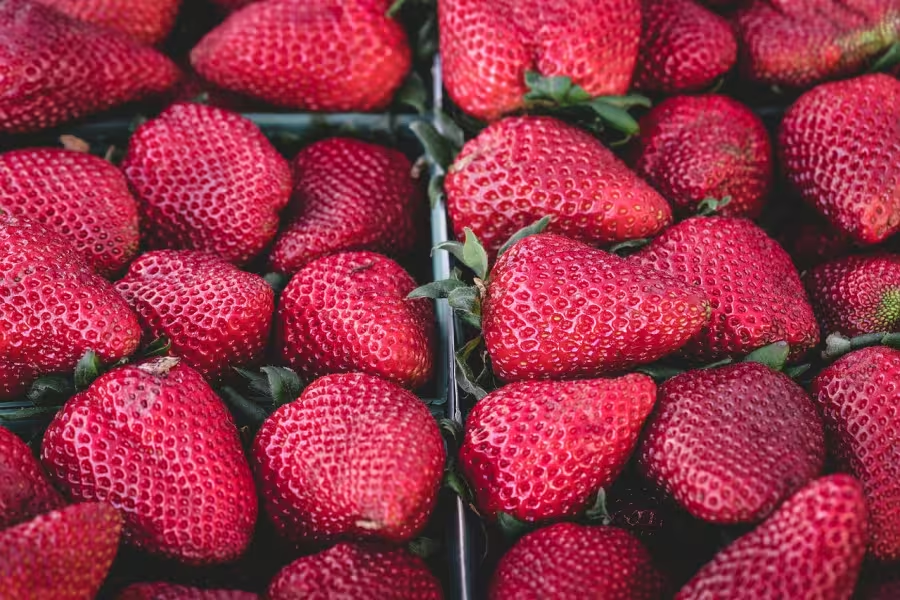
- Strawberries
- Spinach
- Kale, collard, and mustard greens
- Grapes
- Peaches
- Pears
- Nectarines
- Apples
- Bell and hot peppers
- Cherries
- Blueberries
- Green beans
The 2024 Clean Fifteen
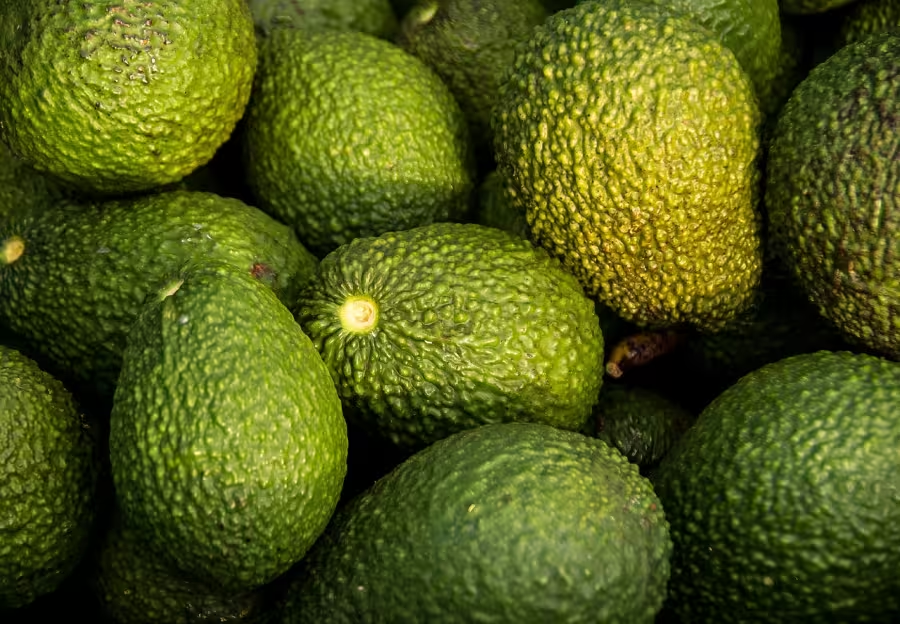
- Avocados
- Sweetcorn
- Pineapple
- Onions
- Papaya
- Sweet peas (frozen)
- Asparagus
- Honeydew melon
- Kiwi
- Cabbage
- Mushrooms
- Mangoes
- Sweet potatoes
- Watermelon
- Carrots
For more information
If you’d like to read the full guide or learn more about the EWG and its research methodologies, you can find that information and so much more on the EWG website.
Your turn
- Do you typically buy organic?
- What is your favorite fresh fruit and/or vegetable?
- What else is on your mind? Anything at all; I just love to hear from you.
Feature image by Григорий Калюжный from Pixabay
Strawberries image by Beth Thomas from Pixabay




I buy organic berries and lettuce and apples, and sometime carrots depending on what is available. I knew there were concerns with all fresh vegetables and fruits, but I adore almost all of them so I buy what looks freshest and hope for the best.
I agree, Ally. I want to enjoy fresh fruits and vegetables, so these lists will be helpful in considering organic, but if one or the other looks better, that’s what I will choose.
I tend to buy based on freshness and what’s at the markets. I look for free-range when it comes to meat and eggs and sustainable when it comes to seafood, but these lists are a great way of deciding where to get the biggest bang for your organic buck.
Buying based on freshness seems to be the most common practice, Joanne. Also, buying free range eggs. I’m going to look into that myself.
I occasionally buy organic, but more often go by what looks good. Do you know if you can clean some of the pesticides and other chemicals off of the produce?
Hello Cindy! Evidently, you can wash off some of the pesticides, but not all. From what I’ve read, the most effective way to wash produce is under running water (not soaking).
Hi Cindy – I try to buy seasonally as much as possible and (like Jo) always aim for free range with my eggs, local fish etc. I think Australia has always had produce that’s fresh and easily accessible because we tend to prepare our own food and eat out less than other Western countries….although that’s changing too.
That’s another good point, Leanne…buying seasonal is better for the environment, but also as I understand it, more nutritious. Whenever we travel somewhere that more of the produce is grown locally, I find the flavor to be better as well.
and excuse the “cindy” I was reading the comment above and my brain morphed cindy for christie – I think I must be getting old!!!!
No worries. Cindy is my sister, so I’m used to people calling me by her name. 😂
Hi Christie, I buy organic for some items and I tend to go for free range eggs rather than caged etc. We can get some lovely fresh fruit and vegetables here in Australia. Thanks for linking up with #WWWhimsy xo
Yet another reason for me to visit Australia!
It’s good to know more about the differences and how food is produced.
I tend to buy little fresh produce these days because of my limited eating capacity.
I do however, buy in season as best I can.
Thanks for sharing.
Denyse #TeamWWWhimsy
I imagine navigating those food limitations would be challenging, Denyse. I’ve been blessed to not have any food sensitivities…at least thus far in my life.
When I read your heading Christie, the word that popped into my head was ‘sometimes’. I buy organic sometimes. To buy organic I need to go to an organic store at the other end of town. If that store was closer to me, I think I’d buy organic more often. I don’t really care about the cost, it’s more about the taste. We have a farmers market on one Saturday morning in the month. I never miss it and there is the opportunity is there to buy organic. I have noticed that some people think that everything there is organic because they are buying direct from the grower, and don’t understand about chemical use etc.
I would love if I had access to a farmers market year-round. Here they are limited to late summer/early fall. That’s an interesting point that you highlighted. I’m sure many people equate local farmers with organic produce, which isn’t the case at all. There are advantages to buying direct, but organic isn’t necessarily one of them.
This was an interesting read Christie and like many of the others I try to buy fresh, seasonal produce too but this can be limited in my small town supermarket. I’d love to have more choice available where I live.
#TeamWWWhimsy
Seasonal produce is somewhat limited where I live too. I have plenty of access to produce, but the growing season is shorter than many places. I do what I can and still enjoy a variety.